
Blog

BlogStephan Wiedner
We discuss the trends we saw at this year's annual social work educators conference (CSWE): the openness to AI technology, the challenge for transitional social workers, the need for pedagogical rigor, and the core of micro conversations.
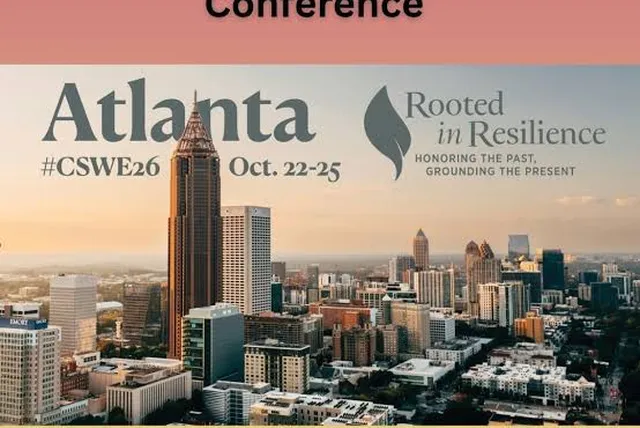
Walking the floor at this year’s CSWE Annual conference made one thing unmistakably clear: social work education has crossed an inflection point.
We have exhibited at CSWE twice before, and the change in energy this year was palpable. In previous years, conversations revolved around cautious skepticism: Is AI ethical in our field? Do we really need virtual simulations? This year, the nature of the questions had shifted. Various deans, field directors, and faculty visited our booth with a specific mandate from their leadership: evaluate the market and choose a platform. The question is no longer, "Do we need AI simulation?" It has become, "Which AI simulation platform actually works?"
Yet amid the rush to adopt simulation tools, the most urgent conversations we had weren't about technology at all. They were about a growing crisis in social worker field readiness - and why shiny technology without pedagogical depth will only make it worse.
During a conversation with an Executive Director representing one of the chapters of the National Association of Social Workers (NASW) framed the central challenge facing social work today.
When graduates leave MSW and BSW programs, they enter agency settings as pre-licensed professionals and are represented by NASW as "transitional" members. The feedback coming from field supervisors on the ground is sobering: new graduates are increasingly under-equipped for the daily interpersonal realities of the job.
They struggle to hold difficult, boundary-testing conversations with clients. They struggle to navigate complex inter-agency conflict with colleagues. And when these struggles surface, an institutional blame game takes hold:
Field supervisors argue: "Our caseloads are overwhelming; it is not our job to teach entry-level professionals how to conduct foundational dialogue."
Universities argue: "Our curriculum meets accreditation standards and covers competencies thoroughly; our job is done."
Professional associations and students are caught directly in the middle, threatening to increase rates of early-career attrition.
The field is demanding practitioners who can communicate effectively from day one, but students rarely get the safe, repeatable practice required to build that muscle before their first client encounter.
As faculty toured the exhibit hall they noted the emergence of new players in the simulation field. What was evident to the attendees is that creating realistic AI simulations is basic table stakes technology now. What appeared to peak the curiosity of attendees was our banner that cut through the noise: “Others focus on AI simulation. We care about the pedagogy.”
In 2026, spinning up a conversational avatar to play a "resistant client" is the easy part. Any tech startup can create a simulation overnight. In fact, we even met some resourceful instructors who had figured out how to create basic simulations using ChatGPT.
The hard part - the part we have spent the last ten years refining - is building the instructional architecture that transforms an interaction into durable behavioral change.
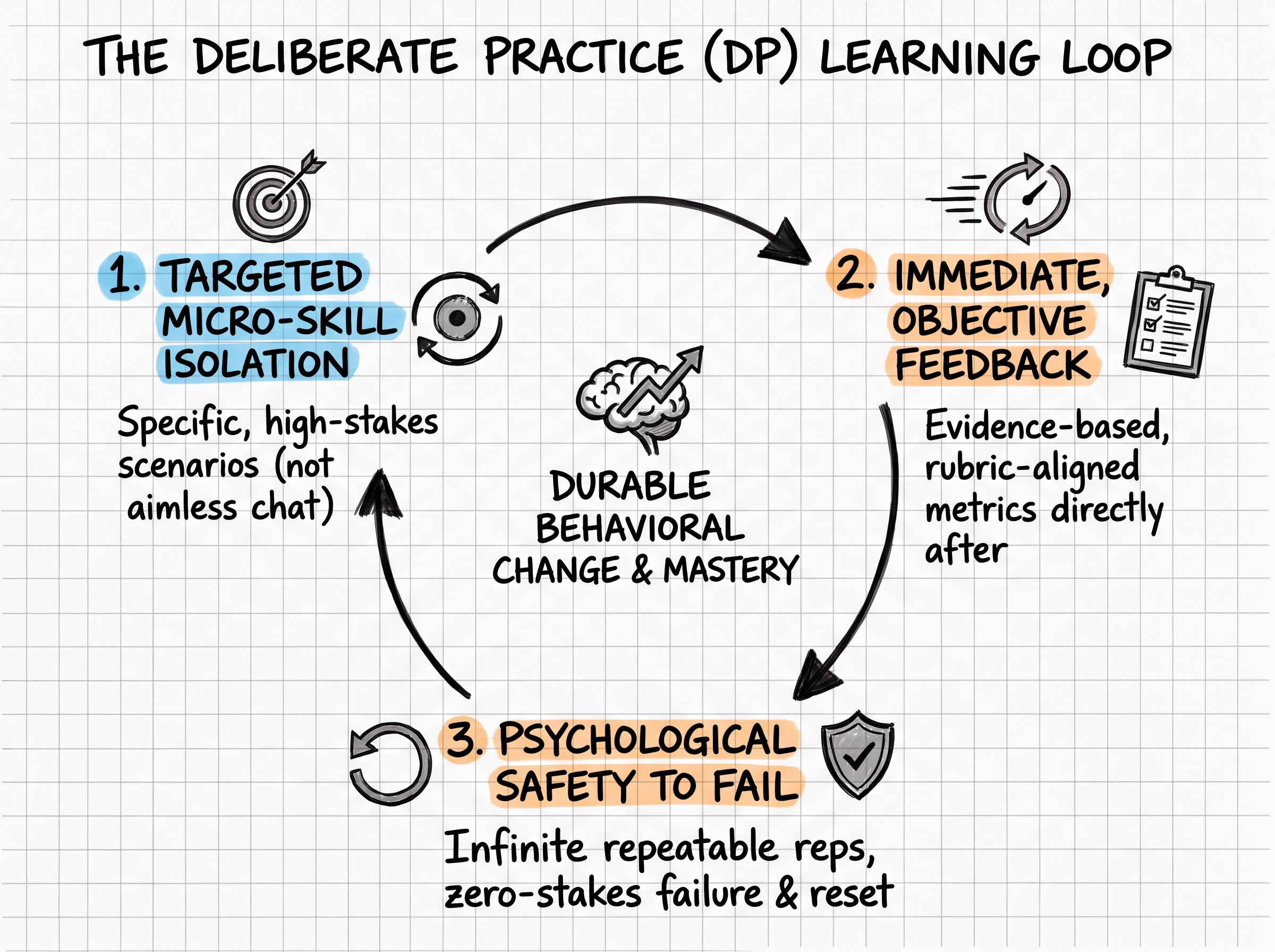
Unstructured AI chat without intentional scaffolding does not teach; it merely exposes students to a simulated client. Drawing on Bruce Wampold’s foundational research on Deliberate Practice (DP) and clinical skill acquisition, our focus is not on the novelty of the bot, but on the rigor of the learning loop:
 Faculty don't need another tech toy. They need a proven pedagogical engine that relieves the burden on overworked field supervisors and turns theoretical knowledge into demonstrable skill.
Coming from counseling, social work education rightly emphasizes meso and macro considerations in a much more explicit way. Social workers think about dismantling systemic racism, reforming the penal system, analyzing poverty policies, and understanding structural oppression. The sheer scale of what social workers must navigate can be paralyzing.
Yet true social justice is not delivered in the abstract; it is delivered one human relationship at a time.
You cannot repair a broken foster system if you cannot sit across from a terrified, hostile teenager and make them feel genuinely seen. You cannot mitigate structural trauma if you do not know how to hold space for a client’s grief without getting defensive. While social work students must carry a systemic lens, what the client in front of them likely needs in the moment is simple. They need genuine human connection: reassurance that someone is in their corner and capable of bearing witness to their experience.
That kind of relational competence does not happen by accident. It is a set of skills that must be practiced deliberately and honed over hundreds of repetitions.
As programs across the country move to implement simulation tools this year, the differentiator will not be who can provide the most realistic avatars. Instead, the differentiator will be who can leverage technology to teach better skills at scale - without burdening students or faculty with 100s of hours of more work.
Closing the readiness gap requires moving beyond passive exposure and toward intentional deliberate practice. We look forward to continuing that work with the educators shaping the future of this profession.
Continue reading
Blog
Blog
Blog

Blog

Blog

Blog
