
Blog

ResearchStephan Wiedner
In a randomized study of 42 Portuguese psychology master’s students, deliberate practice produced better empathic responses than training as usual. Here is what it showed, and what today’s technology could test next.
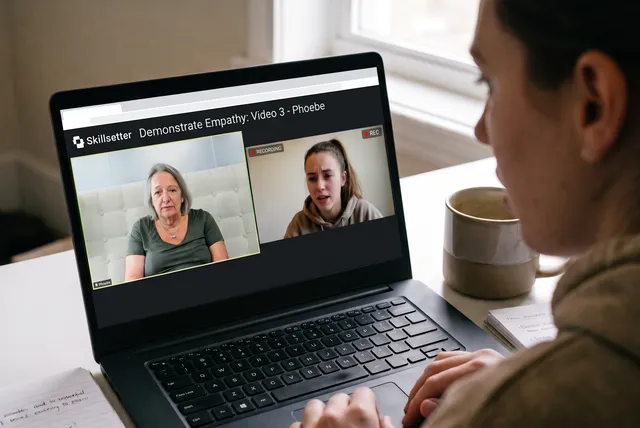
A 2025 randomized study from Portugal compared deliberate practice (DP) with training as usual (TAU) for empathic communication in clinical psychology master’s students. Over four weeks, students in the DP group delivered higher-quality empathic responses than students in the TAU group. The study was small and short, and it measured responses to recorded scenarios rather than work with clients, so it is early evidence, not proof.
Disclosure: The study used the Theravue platform, now called Skillsetter. This post is our summary of the published paper. Please read the original for full methods and limitations: Tomás et al. (2025), Journal of Expertise, 8(1).
42 clinical psychology master’s students were randomly assigned to deliberate practice (23) or training as usual (19).
Over four weeks, participants recorded responses to eight client videos across four evaluation moments.
The DP group showed significantly better quality of empathic interventions than the TAU group (p = 0.021 and p = 0.045 in the two reported analyses).
Within the DP group, scores did not change significantly across the four evaluation moments (p = 0.122).
In the TAU group, quality rose at first and then declined significantly (p = 0.001).
More solo practice was associated with better empathy quality only at the final evaluation moment (r ≈ 0.47).
Research widely suggests that deliberate practice helps students turn knowledge into skill. The authors note, however, that psychotherapy skills training has received limited attention in this literature. Many master’s programs teach empathy mainly through lectures and readings, so the practical question is whether structured practice with feedback does more.
The research team collected data in November and December 2020. Everyone attended a mandatory online opening meeting. Participants were randomized to DP or TAU and followed a four-week schedule on the Theravue platform. Both groups received weekly emails listing tasks and kept a logbook.
The assessment task (same for both groups). Each week, participants watched two new client videos (30 to 90 seconds, an actor depicting a realistic counseling scenario) and recorded a response as though they were in the room with the client, then submitted it. Week 1, videos 1 and 2, was the baseline. Eight videos were used in total across four evaluation moments.
Measurement. Two master’s students, blind to condition, independently rated the final responses using the Measure of Expressed Empathy (MEE; Watson, 1999). Agreement between the raters was .817 (reported with a 95% confidence interval), as calculated by intraclass correlation coefficients (ICC).
Training sessions. After the baseline and after each of the next two evaluation moments, participants attended a 90-minute online session, three in all.
Deliberate practice: Groups of five to six met with a certified DP coach. The coach invited each participant to share the responses they had just submitted, gave individual, detailed feedback, and assigned personal exercises beyond the participant’s current ability, covering attitude, voice, responsiveness and understanding of the client’s situation. Between sessions, participants practiced on those same videos at least three times (solitary practice) and logged it.
Training as usual: All 19 participants attended one lecture-style session led by a university lecturer who was also a therapist with more than five years’ experience. It was designed to resemble traditional training. The instructor presented literature on empathy and its link to clinical outcomes, covering the same therapist components, with discussion and further reading to do outside the session. There was no practical application.
Videos 7 and 8, the final evaluation, followed the third session.
The central finding is the comparison between groups: DP students’ empathic responses were rated higher in quality than TAU students’.
The pattern over time needs careful reading. The DP group did not change significantly across the four evaluation moments. The TAU group improved early and then declined until the last evaluation, which the authors note only partly supported their hypothesis that scores would stabilize. So the study does not show DP students climbing steadily. It shows them holding a higher level while the TAU group fell back.
Solo practice was linked to quality only late. There was no relationship at the earlier evaluations (videos 3 to 6). At the final moment there was a positive link (video 7, r = 0.473, p = 0.023; video 8, r = 0.468, p = 0.024; n = 23). Because this is a correlation within one group, it cannot show that practice caused the difference.
The results are encouraging for programs that want to build empathy through practice. The limits are real:
Small sample: 42 participants in two groups of unequal size.
Short duration: four weeks, with three training sessions. The authors note that DP effects often need longer, ongoing effort, so four weeks is not long.
No long-term follow-up.
Scenario-based outcomes: the study measured recorded responses to videos, not behavior with clients or client outcomes.
What differed between groups: the DP group had coach feedback on their own responses, personalized exercises, small-group sessions, and repeated solo practice. The TAU group had a lecture. The study can’t say which of the DP ingredients mattered most.
The study ran in late 2020. Since then, immediate AI feedback and conversational AI avatars have become widely available. This section is our perspective on questions the study invites, not findings from the paper.
Deliberate practice here was a package: individual feedback from a coach on a submitted performance, exercises just beyond current ability, repeated practice on the same scenarios, and a small group. The paper tests the package against traditional training. A useful next question is which ingredients are doing the work, and whether newer tools could deliver them better.
Feedback timing. The coach’s feedback came in a session after each submission. Would immediate feedback help more because the attempt is fresh, or less because it skips the reflection that preceded a coaching call?
Feedback source. Would learners trust and act on AI feedback as they would a certified coach’s?
Observing feedback of peers. Coaching sessions had five to six participants. Do learners gain from seeing peers’ work, which private AI feedback wouldn’t offer?
Combined human and AI feedback. Is the strongest design AI for frequent feedback and a coach for judgment?
Preserving difficulty with AI avatar conversations. Short videos with an actor can be chosen to be hard and thus produce differing quality of responses. Would a conversation with an AI avatar behave sufficiently the same each time so differences in scores could be attributable to learner skill and not just differences in stimuli?
Emotional realism. Does an AI character convey distress convincingly enough to create the pressure of a real session?
Dose. Solo practice only correlated with quality at the final evaluation, after three rounds. We suspect that continuous practice over longer periods would produce larger improvements than four weeks can show, but this study wasn’t designed to test that.
Automated measurement. The MEE rates single responses. Can it be adapted to full conversations, and could AI rate them reliably enough to support learners at scale?
Research that answers these would help programs decide how to design practice, not just whether to use it.
In this randomized study, DP students delivered higher-quality empathic responses than TAU students. Given the small sample and short follow-up, this is early evidence.
Not significantly. The DP group’s scores did not change significantly across evaluation moments, while the TAU group’s rose early and then fell.
Two blinded raters scored each final response with the Measure of Expressed Empathy (Watson, 1999).
Three 90-minute small-group sessions with a certified coach who gave individual feedback on submitted recordings and assigned exercises, plus repeated solo practice on those videos, logged in a logbook.
Theravue, which is now Skillsetter.
Yes. Skillsetter is available to researchers, generally at no cost unless a study needs a unique setup or costly custom content. Contact the Skillsetter team.
Tomás, M., Sousa, D., Barata, M., Amaro, I., & Coelho, P. (2025). The effect of a deliberate practice training on the delivery of empathetic interventions in clinical psychology master students. Journal of Expertise, 8(1). https://www.journalofexpertise.org/articles/volume8_issue1/JoE_8_1_Tomas_etal.pdf
Published under a Creative Commons Attribution 3.0 licence.
Continue reading
Blog
Blog

Blog

Blog

Blog

Blog
