
Blog

BlogStephan Wiedner
How Skillsetter designs deliberate practice: start with what learners need to learn, break the skill into parts, and scaffold practice cases to where learners are, from watching and analyzing a client to a live conversation simulation.
Last updated: November 20, 2026
"Deliberate practice" is used to describe a lot of different training activities. This page explains how we put it into practice at Skillsetter. It covers the questions we start with, the types of practice cases we use, how we sequence them for different learners, and the research behind our decisions. It reflects our approach as of the date above, and we'll keep updating it as we learn.
Start with the learning goal. What should learners be able to do? We break that skill into its component parts.
Design practice cases as foils for performance. Each practice case is a situation built to draw out a specific part of the skill.
Scaffold to the learner. We choose and order practice cases to sit just beyond what learners can already do, which educators call the zone of proximal development.
Give feedback, then let learners try again. Every practice case can include AI, instructor or peer feedback, followed by a re-attempt.
Adjust as learners progress. Move learners forward when they're ready, and back a step when a part of the skill is missing.
Every course design starts with the same question: what are you trying to teach? Only then do we choose practice cases.
Take building rapport with a new client. It sounds like one skill, but it's several:
showing curiosity about the other person, including through nonverbal behavior
asking open questions
reflecting what the client says
reflecting what the client feels
Once the parts are clear, we design practice cases as foils for performance. A foil is a situation chosen to draw out one or more of those parts so a learner can practice it and get feedback on it. A client who gives short answers is a foil for open questions. A client who hints at an emotion without naming it is a foil for reflecting feelings.
Scaffolding means building a skill one layer at a time, with each practice case resting on the one before. We use a principle that comes up often in deliberate practice research: the zone of proximal development. That's the range of tasks a learner can't yet do alone but can do with the right support. Practice that's too easy doesn't build skill. Practice that's too hard leads to frustration and guessing.
So the right practice cases depend on where learners are in their training. For example:
Early in a program, or when a topic is brand new, we lean on analysis practice cases. Learners watch, describe and compare before they're asked to perform.
Later in a program, say a year or more in, we use more performance practice cases, where learners record their own responses or hold a conversation. These are more demanding.
Programs differ in when they introduce topics. Some teach theory at the very start and others later, so the same skill may need a different starting point in different programs.
Our practice cases come in two families:
ActorSims are video-based practice cases. Trained actors portray clients in short, standardized videos, so every learner responds to the same client moment. Watch and analyze, watch and compare, and practice and self-assess are all ActorSims.
ConvoSims are conversation simulations with an AI client, either voice only or with an animated avatar.
Within those families, we use four main types of practice cases, from least to most demanding.
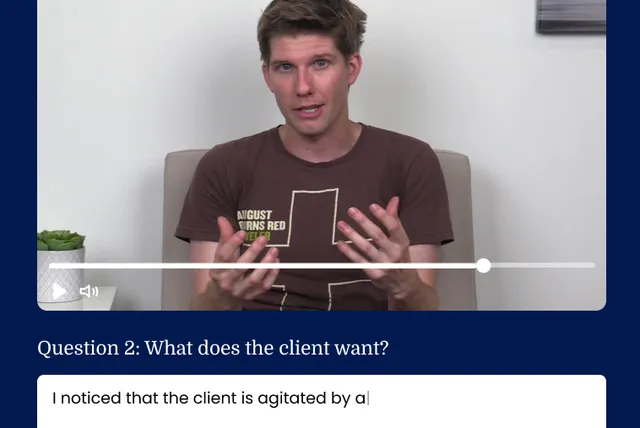
The learner watches a short video of a client and describes in writing what's going on for them. No response is needed yet. This builds noticing: picking up the client's feelings, needs and context before trying to respond.
The learner watches two short videos, each showing a client and a practitioner's response. One response shows the skill done poorly and the other done well. Seeing the contrast helps learners recognize the parts of the skill before they try it themselves.
Why we include it: Watching modeled therapist responses, combined with structured practice, has been shown to improve trainees' facilitative interpersonal skills (Anderson et al., 2020). Learning to identify therapy processes when you see them is also argued to build the expertise to carry them out (Westra & Di Bartolomeo, 2024).
The learner watches a client video, records their own response, and assesses it against the skill criteria. They can re-attempt as often as needed, and each attempt focuses on one part of the skill against a standardized client moment.
Why we include it: This is the core deliberate practice cycle of rehearsing a specific skill, getting feedback and trying again. Randomized trials have tested this cycle for empathy (Larsson et al., 2025) and for consultation communication skills (Newman et al., 2022). A systematic review describes how deliberate practice is defined and used in psychotherapy training (Diamond et al., 2025), and a trial protocol applies it to recognizing and responding to alliance ruptures (Boritz et al., 2026).
The learner has a back-and-forth conversation with an AI client, so the skill has to hold up across several exchanges as the conversation unfolds. We offer two versions: voice only, and voice with an animated avatar whose face and body language also have to be read. We usually put voice only first, because it gives learners fewer cues to track at once. We don't yet know which is easier from a deliberate practice point of view.
Why we include it: For voice-based simulation, a randomized study of more than 90 novice counselors tested whether LLM-simulated practice and feedback can build counseling skills (Louie et al., 2026), and a study examined how AI-enabled virtual patient simulation affects training outcomes and trainee insecurities in psychotherapy education (Cecil et al., 2026). Avatar-based simulation is newer. Early work described building AI virtual patients for nursing communication training (Shorey et al., 2019). A scoping review found AI in health care communication training promising but limited by access, conversational flow and authenticity (Stamer et al., 2023). A 2026 review of mental health training found digital simulations feasible and well accepted, while simulations with live human actors, playing clients in real time either in person or over video, remained more effective for interpersonal skills (Juranek, 2026). These are different from ActorSims, which use recorded actor videos. Still, the finding suggests AI conversation shouldn't be the only kind of practice, which is one reason we treat ConvoSims as a later step that builds on ActorSim practice rather than a replacement for it.
For a new skill, a full progression often looks like this:
Watch and analyze (ActorSim)
Watch and compare (ActorSim)
Practice and self-assess (ActorSim)
Practice and self-assess with a new client (ActorSim), so the skill isn't tied to one scenario
Conversation simulation, voice only (ConvoSim)
Conversation simulation with an avatar (ConvoSim)
Each step adds difficulty: noticing what the client is experiencing, recognizing the skill in someone else, producing it yourself, transferring it to someone new, and keeping it up in real time. Not every course needs every step. Where learners start depends on their zone of proximal development.
A new learner might start with a watch and compare ActorSim to understand what building rapport involves, seeing it done poorly and done well. Next comes one practice and self-assess ActorSim for each part of the skill: curiosity, open questions, reflecting content and reflecting feelings. The sequence ends with a ConvoSim where they bring the parts together.
An advanced learner might go straight into a ConvoSim. If it's clear they're missing an important part of the skill, for example they ask good questions but rarely reflect feelings, we can drop them back a step or two. They practice that part on its own, then return to the conversation.
Every practice case has the same loop. After an attempt, the learner can get immediate AI feedback, feedback from an instructor, feedback from peers, or any combination of these. After any round of feedback, they can re-attempt the same practice case.
Learners tell us they value both AI and human feedback. Making feedback source and timing a choice lets programs use AI feedback for frequent, immediate input and keep instructor time for judgment.
Instructors decide which practice cases to include, in what order and how many of each. In practice, we see three broad groups, and we value all of them:
Many use our model courses as they are. These follow the approach on this page and are ready to use.
Some make small adjustments, such as reordering steps, adding practice cases for a skill their program emphasizes, or changing which feedback sources are on.
Some experiment boldly, testing unusual sequences and combinations with their students. These instructors often teach us something new about what works.
This approach is our current best design, informed by research on its parts. It's one way to structure deliberate practice, not the only one, and the field is still learning which combinations work best for which skills and learners. For each question below, there are two things to ask: what learners prefer, and what actually improves their skill. The answers may not match.
Sequencing. Do learners gain more from moving through practice case types in order than from doing the same tasks in any order?
Voice vs avatar. Is a voice-only conversation easier or harder than one with an avatar? Do visual cues from AI avatars help or overload learners?
Feedback mix. Where does AI feedback work well on its own, and where does human feedback add the most?
Dose and progression. How many attempts at each step before moving on? Should progression depend on scores?
Transfer. Do gains in simulated practice show up in sessions with real clients?
Other ingredients. Feedback timing, how practice is spaced over time, practicing alone vs in a group, and the role of modeled examples and self-assessment are all worth testing on their own and in combination.
If you're a researcher interested in these questions, Skillsetter is available for research, generally at no cost unless a study needs a unique setup or costly custom content. Contact the Skillsetter team.
Rehearsing a specific skill just beyond your current ability, getting feedback and trying again. Studies define it in different ways (Diamond et al., 2025), so it helps to say which kind of practice you mean.
We start with the learning goal, break the skill into parts, and design practice cases that draw out each part. Then we choose and order them based on where learners are in their training.
Building a skill one layer at a time, with each practice task resting on the one before. Early tasks might ask learners to notice and analyze. Later tasks ask them to perform the skill and sustain it in conversation.
The range of tasks a learner can't yet do alone but can do with the right support. We aim to keep practice within that zone, so it's challenging without being out of reach.
Recognizing a skill when someone else demonstrates it helps learners perform it themselves. Seeing a weak and a strong response side by side makes the difference concrete.
Yes. Instructors choose which practice cases to include, in what order and how many of each, and which feedback sources to use. Many use our model courses as they are.
They're Skillsetter's two families of practice cases. ActorSims are video-based practice cases where trained actors portray clients; they include watch and analyze, watch and compare, and practice and self-assess. ConvoSims are back-and-forth conversation simulations with an AI client, either voice only or with an animated avatar.
Not in our approach. ConvoSims usually come after learners have built the parts of a skill in more controlled ActorSim practice. If a learner struggles in a conversation, they can step back to focused practice on the missing part.
Anderson, T., Perlman, M. R., McCarrick, S., & McClintock, A. (2020). Modeling therapist responses with structured practice enhances facilitative interpersonal skills. Journal of Clinical Psychology, 76, 659–675. https://doi.org/10.1002/jclp.22911
Boritz, T., Di Bartolomeo, A. A., Alter, U., & Cooper, M. B. (2026). Enhancing therapists' recognition and responsiveness to alliance ruptures in treatments for borderline personality disorder: Protocol for a pilot randomised controlled trial. Counselling and Psychotherapy Research, 26(3), e70215. https://doi.org/10.1002/capr.70215
Cecil, J., Kokje, E., Kleine, A. K., Schaffernak, I., Vogel, L., Angerer, S., ... & Gaube, S. (2026). The effect of AI-enabled virtual patient simulation on training outcomes and insecurities in psychotherapy education. BMC Medical Education, 26, 115. https://doi.org/10.1186/s12909-026-09917-x
Diamond, G., Wlodek, B., Arthey, S., & Parker, S. (2025). A systematic review of deliberate practice in psychotherapy: Definitions, operationalization, and preliminary outcomes. Psychotherapy, 62(2), 113–131. https://doi.org/10.1037/pst0000569
Juranek, J. F. (2026). Multimodal avatars and human simulations in teaching practical skills and training of clinical psychology, psychotherapy, and related mental health specialists. Psychology Learning & Teaching, 25(1), 5–19. https://doi.org/10.1177/14757257261426784
Larsson, J., Werthén, D., Carlsson, J., Salim, O., Davidsson, E., Vaz, A., Sousa, D., & Norberg, J. (2025). Does deliberate practice surpass didactic training in learning empathy skills? A randomized controlled study. Nordic Psychology, 77(1), 39–52. https://doi.org/10.1080/19012276.2023.2247572
Louie, R., Shah, R. S., Orney, I. H., Pacheco, J. P., Brunskill, E., & Yang, D. (2026, April). Can LLM-simulated practice and feedback upskill human counselors? A randomized study with 90+ novice counselors. In Proceedings of the 2026 CHI Conference on Human Factors in Computing Systems (pp. 1–31).
Newman, D. S., Villarreal, J. N., Gerrard, M. K., McIntire, H., Barrett, C. A., & Kaiser, L. T. (2022). Deliberate practice of consultation communication skills: A randomized controlled trial. School Psychology, 37(3), 225–235. https://doi.org/10.1037/spq0000494
Shorey, S., Ang, E., Yap, J., Ng, E. D., Lau, S. T., & Chui, C. K. (2019). A virtual counseling application using artificial intelligence for communication skills training in nursing education: Development study. Journal of Medical Internet Research, 21(10), e14658. https://doi.org/10.2196/14658
Stamer, T., Steinhäuser, J., & Flägel, K. (2023). Artificial intelligence supporting the training of communication skills in the education of health care professions: Scoping review. Journal of Medical Internet Research, 25, e43311. https://pubmed.ncbi.nlm.nih.gov/37335593/
Westra, H. A., & Di Bartolomeo, A. A. (2024). Developing expertise in psychotherapy: The case for process coding as clinical training. American Psychologist, 79(2), 163–174. https://doi.org/10.1037/amp0001139
Continue reading
Blog

Blog

Blog

Blog

Blog

Blog
