Blog

ResearchStephan Wiedner
A Stanford-affiliated study put AI-simulated patients in a doctoral psychotherapy course alongside Skillsetter video vignettes. Students valued the AI for back-and-forth practice but preferred human feedback. Here is what it found.

A 2026 mixed methods study followed 29 first-year clinical psychology doctoral students through two psychotherapy courses (16 weeks). It tested CARE, a research tool that gives AI feedback and lets students talk out loud with AI-simulated patients, inside the normal course alongside peer role-plays and Skillsetter video vignettes. Using CARE in class was feasible, but students still favoured established methods. They rated peer feedback above AI feedback. In the second course, they rated Skillsetter higher than CARE for learning from mistakes and rated the two platforms about the same on everything else. All outcomes were student self-reports, so the study tells us about experience and acceptance, not about skill gains.
Disclosure: Skillsetter (cited in the paper as Skillsetter, Theravue Inc) was one of the two practice platforms compared. The study was designed and run by researchers at Stanford University and the Palo Alto University–Stanford PsyD Consortium, three of whom developed CARE. This post is our summary of the published paper. Please read the original for full methods and limitations: Converse et al. (2026), Interactive Journal of Medical Research, 15, e93199.
29 first-year PsyD students took part across two courses (September 2024 to March 2025). In the first course, 9 students gave paired ratings. In the second, 25 did.
Peer feedback beat AI feedback for being constructive and helpful (median 3 vs 2 on a 0–4 scale, P=.02) and for recognising areas to improve (mean 5.22 vs 4.33, P=.046).
Skillsetter vs CARE: the one statistically significant difference students reported was for learning from mistakes, where Skillsetter rated higher (mean 4.52 vs 3.20 on a 7-point scale, P=.03). The other four comparisons (immersion, confidence responding spontaneously, communication beyond words and building an alliance) did not differ significantly.
Students valued the AI-simulated patients for interactive, multi-turn practice that single-turn vignettes can't offer, and for rehearsing hard-to-role-play clients.
Students' most common technical complaints about CARE were undetected vocal pauses (80%), patients that didn't feel realistic (56%) and limited emotional expression (52%).
Students' biggest concerns were relational rather than technical: AI replacing peer support (88%) and peer interaction (80%).
Students wanted AI feedback paired with human feedback, not better AI feedback on its own.
Deliberate practice (DP) builds therapy skills through clear goals, repetition, reflection and feedback. The authors note it can outperform standard supervision, but it's hard to scale because one-on-one feedback takes so much faculty time. Video-response platforms such as Skillsetter extended practice outside the classroom. Large language models now make it possible to talk with AI-simulated patients and receive automated feedback.
Most earlier studies of these AI tools ran in labs or as one-off exercises. This study asked a practical question: what happens when AI practice is built into a real course for a whole quarter, next to the methods programs already use?
The study ran in a two-course Learning Psychotherapy sequence at an APA-accredited PsyD program. Stanford's IRB judged it exempt (non-medical), and students could opt out of having their data analysed.
First course (6 weeks): AI feedback vs peer feedback. Each week, students paired up for a 10-minute role-play, taking turns as therapist and client, and recorded the session. Partners then gave each other feedback, as earlier cohorts had done. As an optional extra, students could upload the audio of that same role-play to CARE. CARE transcribed it, separated the two speakers, and gave AI feedback on the student's lines as therapist. The feedback covered eight counselling skills: empathy, validation, reflections, questions, suggestions, self-disclosure, session structure and professionalism. That way, students got two kinds of feedback on the same session: their partner's and the AI's. Of 29 students, 23 uploaded at least one transcript. The survey was voluntary: 14 students completed it, and 9 gave paired ratings of AI and peer feedback.
Second course (10 weeks): two practice packages side by side. Each week, students practised with:
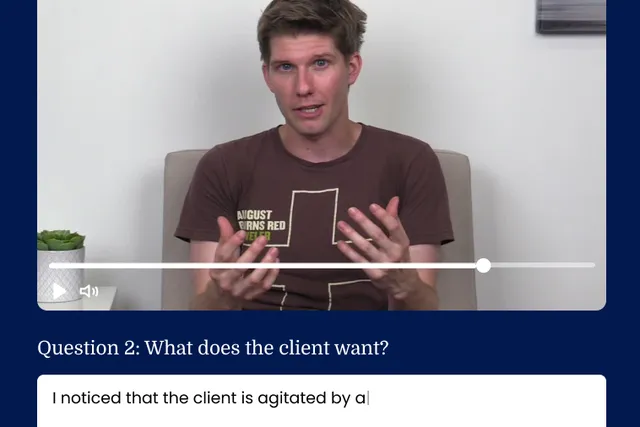
Skillsetter: one recorded reply per attempt (about 1 to 2 minutes) to a standardised, actor-performed client video. Targeted skills included empathy, cultural humility and alliance repair. The instructor and teaching assistants scored replies with a rubric.
CARE: a spoken, back-and-forth conversation with an AI-simulated patient. Each week offered 2 to 4 of 12 scenarios, covering alliance ruptures, mandated reporting, suicide risk and self-injury. Nine of the 12 scenarios were adapted from Skillsetter transcripts. After each session, an AI "mentor" gave feedback on every utterance.
The two were matched for weekly topic, time, rubric and grading weight. CARE started out required. After student concerns, it became optional early in the quarter, and students could complete extra Skillsetter practice instead. Midway through the quarter, a TA began writing weekly feedback on CARE transcripts for 3 to 5 randomly selected students. The quarter ended with a live role-play over video call with an instructor or TA.
Who compared what. Both courses had the same 29 students, one first-year cohort taking the sequence in order (fall, then winter). The study never compares the first course with the second. Each comparison happens inside one course, and each student rated both options. In the first course, they rated their partner's feedback and the AI's feedback on their own role-plays. In the second course, they rated CARE and Skillsetter after using both over the same weeks.
Measurement. At the end of the second course, students completed a 39-item survey (25 of 29 responded). The first course used a shorter voluntary survey. The investigators designed both for this study and did not formally validate them. Open-ended answers were analysed for recurring themes.
Why the paired design matters. Because every student rated both options, the researchers compared each student's two ratings with each other. They didn't compare one group of students with another. The test they used for this (the Wilcoxon signed-rank test) is a standard choice for small samples and rating scales. Think of a taste test where every taster tries both drinks. You look at how each person's score for A differs from their score for B. Then you ask whether those differences lean consistently one way.
The benefit is that each student acts as their own comparison. Some students rate everything generously, some are sceptical of technology, and some arrive with more clinical experience. Those differences cancel out, because each student is measured only against themselves. That makes a fair comparison possible with as few as 9 or 25 students.
A paired design doesn't fix everything, though. Nobody was randomly assigned to a tool or an order. CARE became optional, so students used it different amounts, and 4 of the 29 never used it. The researchers also tested each survey question separately (five in the second course) without adjusting for running several tests. The more questions you test, the more likely one comes out "significant" by chance.
AI feedback vs peer feedback (first course). Peers' feedback was rated more constructive and better at showing what to improve. Comfort receiving feedback did not differ significantly. Students said peers picked up tone, nonverbal cues and silence, while CARE worked only from a transcript and treated each response "separate and apart from the rest." Transcription errors and feedback that kept recommending empathy and validation hurt CARE's credibility. Students did like the AI's alternative phrasings. One even preferred its "broader and more objective feedback."
Video vignettes vs AI-simulated patients (second course). The one statistically significant difference students reported was for learning from mistakes, where Skillsetter rated higher (effect size d=0.49). The survey item read: "The way I could use [CARE/Skillsetter] allowed me to make mistakes I could learn from." The other four comparisons split by direction and were small relative to the spread in responses. Skillsetter was slightly higher on immersion and spontaneous confidence. CARE was slightly higher on communication beyond words and alliance building. Students valued CARE because "you don't get to explore the back and forth with Skillsetter," and because it let them rehearse difficult clients, such as an "angry client, silent client." Several students still volunteered that "nothing replaces role plays." One worried they had learned to chase CARE's approval rather than respond to a person.
Design gaps. Beyond the vocal-pause and realism issues, about two-thirds of students (68% each) wanted three things. They wanted the simulated patient to say how the therapist's responses made it feel, progress tracked over time, and more useful feedback. 64% wanted feedback on the session as a whole. Students responded well to the TA's added written feedback. One wrote that "AI's benefits wouldn't come alive if there weren't human input to modulate it."
Feasibility. Once CARE was part of the course, use was high. Students completed 304 of 319 possible required assignments (95%) with at least four exchanges, averaging about 10 sessions each. The authors note this rate is somewhat inflated because some students did more than one session a week. The supplementary TA feedback took 1 to 2 hours a week.
Acceptance. Students' concerns were mostly about their profession's future, not academic integrity. 88% worried AI would replace peer support, 76% wondered whether they were "just doing user testing for a product," 64% raised environmental impact, and 48% worried their data could help build an AI therapist. Many were open to AI for training and admin tasks but drew a firm line at clinical care.
The study is a useful, honest look at what students experience when AI practice enters a real course. The limits matter:
One cohort, one highly selective, heavily supervised program. Students with less access to expert feedback might value AI tools differently, as the authors themselves note.
Small samples: 9 paired ratings in the first course and 25 in the second, using surveys the investigators designed for this study and did not validate.
No random assignment: the paired design means each student is compared with themselves, but students weren't randomly assigned a tool or an order, and their use of CARE varied once it became optional.
Self-report only. No skill, competence or client outcome was measured, so the study can't say which method builds skill better.
Bundled packages: the comparison mixed voice vs video, multi-turn vs single-turn, AI vs human feedback, and research prototype vs established platform. The authors say clearly that this was not a test of "AI vs traditional training," and the design can't show which factor drove any difference.
No correction for multiple comparisons. Treat the single significant Skillsetter–CARE difference as a signal to test further, not a settled result.
A specific tool at a specific moment: CARE used the best available components as of December 2024. Some technical problems may not apply to newer systems.
This section is our perspective on questions the study raises, not findings from the paper.
The study compared two packages, and each combined several ingredients. Programs designing practice today need to know which ingredients matter.
Iteration may explain "learning from mistakes." The paper describes each Skillsetter task as a single-turn response: one video, one recorded reply per attempt. It doesn't mention that Skillsetter lets learners re-attempt the same video and prompts them to review the rubric before trying again. Multiple attempts are on by default in Skillsetter, and as the platform provider we can confirm they were enabled in this course. Each attempt is short, but the design builds in a cycle of making a mistake, reviewing it and trying again. That's a plausible reason students rated Skillsetter higher on "making mistakes I could learn from," though the study didn't test it.
Feedback source vs practice format. Skillsetter replies got rubric-based feedback from instructors. CARE sessions got AI feedback. Was "learning from mistakes" higher because of the vignette format, the chance to re-attempt, or because a human was giving the feedback? A design that varies only the feedback source would answer this.
Hybrid feedback. Students reacted best when a TA added comments to AI feedback. How much human input is enough, and where does it add the most value: spotting patterns over time, judging the whole session, or confirming the AI is right?
Different practice formats as steps, not rivals. The study set video vignettes and AI conversations side by side, as competing options. We think they work better in sequence: build a skill in controlled, focused practice, then apply it in open-ended conversation. That's our hypothesis, not something this study tested.
Realism vs psychological fidelity. The authors point to simulation research suggesting psychological fidelity matters more than surface realism. How realistic does an AI patient's voice need to be before students engage with it the way they would with an actor or a peer?
Session-level feedback and progress tracking. Students asked for feedback on the whole conversation and on their growth over time. Can AI feedback reliably assess flow, alliance and repair across a session rather than one utterance at a time?
Trust and transparency. Many students' reservations were about data use and the industry behind AI. Which commitments matter most for acceptance: clear data policies, no training of AI therapists on student data, or keeping peer and supervisor contact intact?
Context. In programs with fewer supervision hours, AI practice may fill a bigger gap. Would the same students' ratings differ in a lower-supervision setting?
Testing the ingredients of deliberate practice. As the authors recommend, future studies should measure skill directly, using supervisor ratings, behavioural coding or structured assessments. They should look at two questions for each ingredient: what learners prefer, and what actually improves their skill. Those answers may not match. Feedback source (AI-only, human-only or hybrid) is one ingredient. Others worth testing include:
feedback timing and frequency
how many attempts learners make, and whether they re-attempt after feedback
the kind of stimulus: actor video, voice-only AI, AI avatar, peer role-play or live clients
single responses vs multi-turn conversations
watching modelled examples of the skill done well and done poorly
self-assessment against a rubric
how difficulty increases, and in what order tasks come
how practice is spaced over time, and the total amount
practising alone vs in a group
Our own approach to sequencing these ingredients is one design among many. The field is still early in learning which combinations work best, for which skills and for which learners.
The study used "deliberate practice" for two quite different activities and tested them as alternatives. We think of them as different steps in one sequence. Skillsetter now scaffolds skills like empathy through six steps, from watching and analyzing a client to conversation simulation with an AI avatar. Every step includes AI, instructor or peer feedback and the chance to re-attempt. In that sequence, this study's Skillsetter vignettes and CARE conversations correspond roughly to steps 3 and 5. It's one possible design, not the only one. For the six steps and the research behind each one, see How Skillsetter Designs Deliberate Practice: Start With the Learning Goal, Then Scaffold.
Under this view, the question becomes less "which tool is better?" and more "which task, at what point, with what feedback?"
Research that answers these questions would help programs decide how to combine practice formats and feedback sources, not just whether to use AI.
Neither overall. Ratings were similar on four of five dimensions. Skillsetter was rated higher for learning from mistakes. Students valued AI patients for back-and-forth practice but found them less realistic and still preferred practising with people.
Less than peer feedback. They rated peer feedback as more constructive and better at showing what to improve, but they appreciated the AI's alternative phrasings. They responded best when a human added to the AI feedback.
No. The study measured students' perceptions, not skill. The authors call for future studies with objective measures of competence.
Every student rated both options, so each student's ratings were compared with their own. This paired design cancels out differences between students, such as how generous a rater someone is or how they feel about technology. The trade-off is that students weren't randomly assigned, so the comparison is still limited.
A research platform built at Stanford. Students could talk out loud with AI-simulated patients (built on the GPT-4o Realtime API) and receive utterance-level feedback from a fine-tuned language model. It was a prototype, not a commercial product.
CARE and Skillsetter, along with peer role-plays. Skillsetter was formerly known as Theravue.
Yes. Skillsetter is available to researchers, generally at no cost unless a study needs a unique setup or costly custom content. Contact the Skillsetter team.
Converse, E., Louie, R., Safer, D., Pacheco, J. P., Fang, W., Kent, J., Arnow, B., & Yang, D. (2026). Classroom integration of AI-simulated patients and automated feedback in doctoral psychotherapy training: Longitudinal mixed methods study. Interactive Journal of Medical Research, 15, e93199. https://doi.org/10.2196/93199
Originally published in the Interactive Journal of Medical Research (https://www.i-jmr.org/2026/1/e93199). This is an open access article distributed under the terms of the Creative Commons Attribution License (https://creativecommons.org/licenses/by/4.0/), which permits unrestricted use, distribution, and reproduction in any medium, provided the original work, first published in the Interactive Journal of Medical Research, is properly cited.
Continue reading
Blog

Blog

Blog

Blog

Blog

Blog
